How high to hang pictures: the 57-inch rule and when to break it
The 57-inch rule puts the centre of a picture 57 in (145 cm) above the floor. Here is the arithmetic for the nail, and the cases where furniture, stairs or a group change the answer.
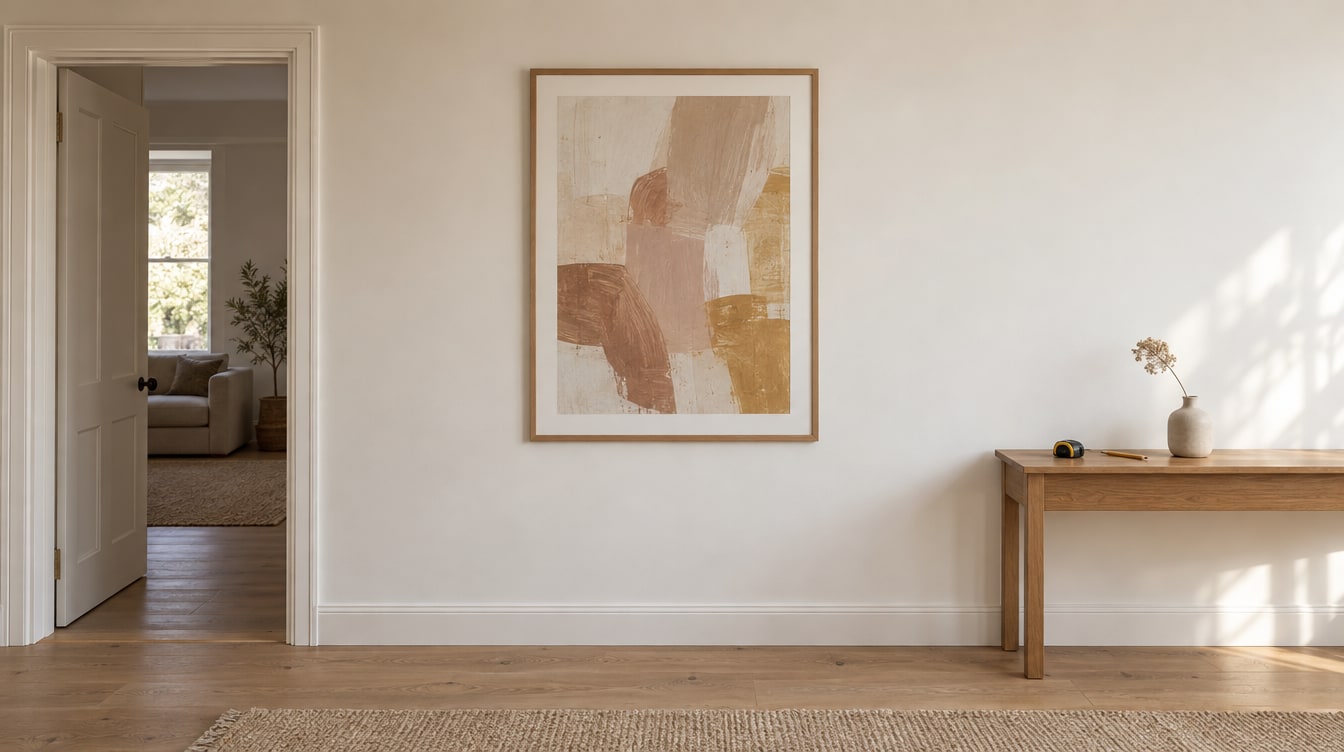
The short answer to how high to hang pictures is that the centre of the picture goes 57 in (145 cm) above the floor. Not the top of the frame, and not the nail. The centre.
Galleries and museums work to that line, or a little above it, up to about 60 in (152 cm). It keeps the pictures in a room on one shared level, whatever their sizes. A centre height is not yet a pencil mark for the nail, so the arithmetic that turns one into the other comes first. The exceptions follow.
The 57-inch rule, and why it is measured to the centre
The rule is usually described as average eye level. In practice the line sits slightly below the standing eye line of most adults, which suits a home: pictures are seen from chairs as well as from doorways.
Measuring to the centre is what makes the rule work across sizes. A small frame and a large one with their centres on the same line look deliberate side by side. Hung with their tops level, or placed by eye, they rarely do.
Anything in the range works. Pick one height for the room and keep to it. Under high ceilings, go towards 60 in (152 cm).
How high to hang pictures: working out where the nail goes
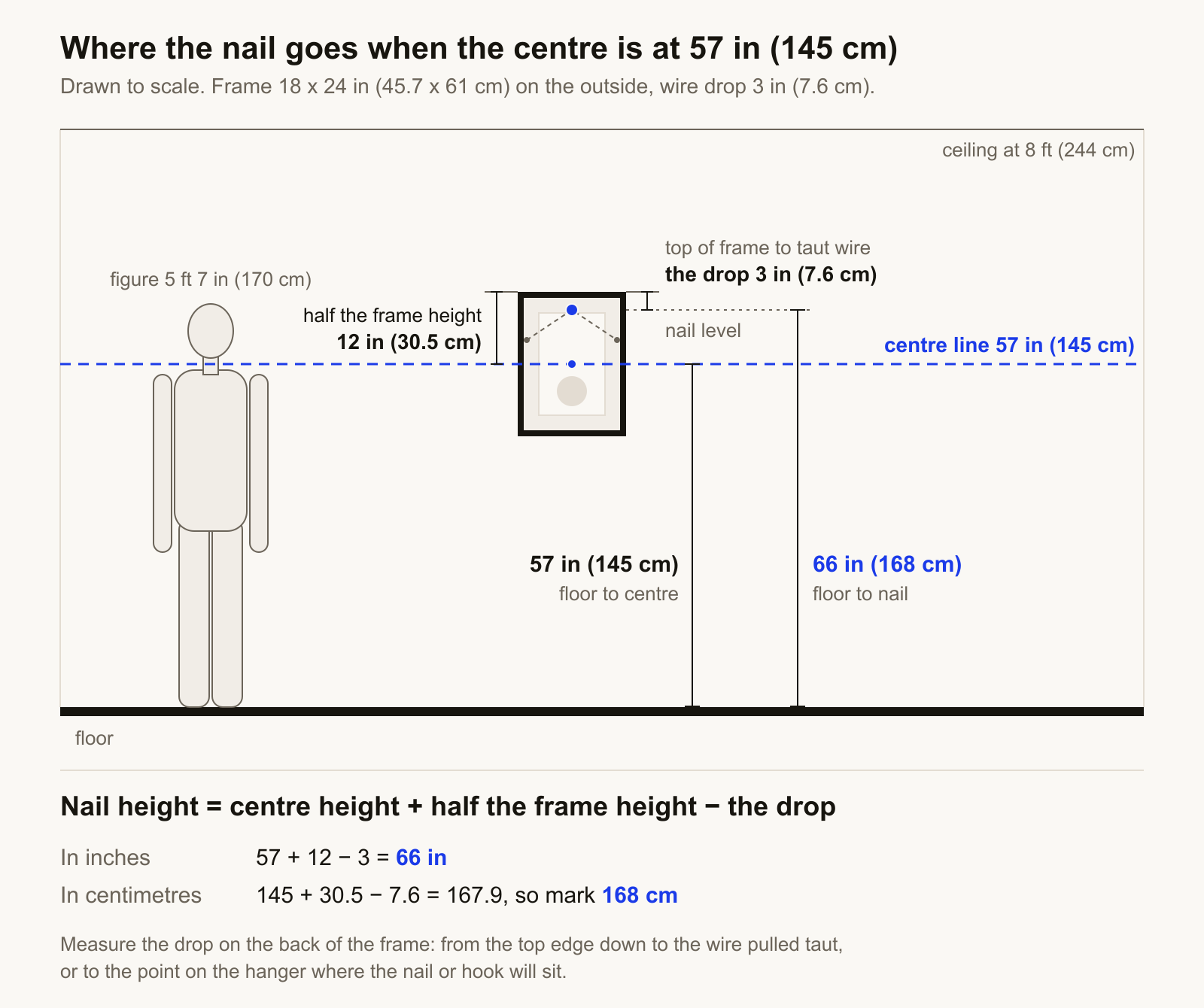
The nail is never on the centre line. It sits above it by half the height of the frame, less the amount the wire or hanger drops below the top edge. As a sum:
Nail height = centre height + half the frame height − the drop
- Measure the outside height of the frame and halve it.
- Turn the frame over. Pull the middle of the wire taut towards the top, as it will sit on the nail. Measure from the top of the taut wire to the top edge of the frame. That distance is the drop.
- Add the half height to the centre height, then subtract the drop.
- Measure that height up from the floor and mark it in pencil. With a picture hook, the mark is where the cradle of the hook will sit, not where its pin enters the wall.
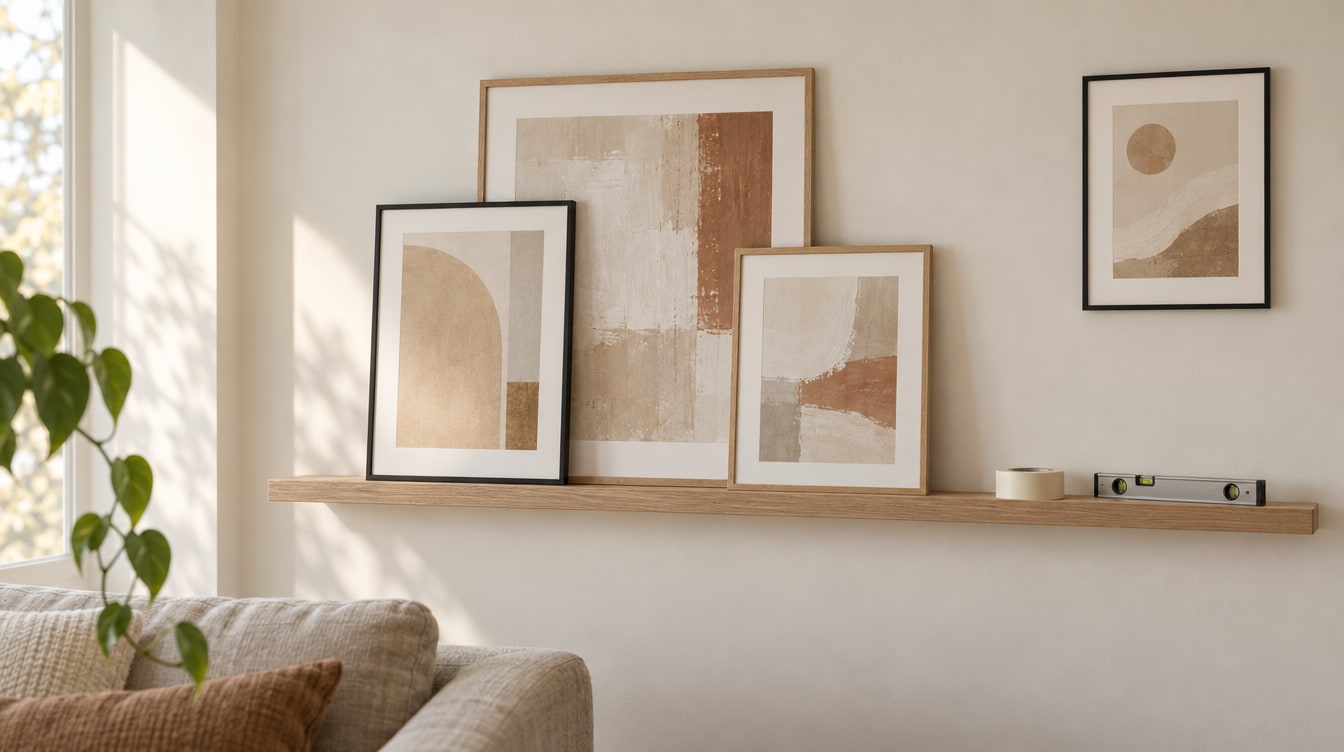
- Hang the frame, then check it with a spirit level.
Worked example: a wired frame
A frame 24 in (61 cm) tall, with a wire that pulls up to 3 in (7.6 cm) below the top edge. In inches: 57 + 12 − 3 = 66. In centimetres: 145 + 30.5 − 7.6 = 167.9. The nail goes 66 in (168 cm) above the floor, and the centre of the picture lands on the line.
Worked example: a sawtooth hanger
A sawtooth hanger sits close to the top edge, so the drop is small. For a frame 15 in (38 cm) tall with the teeth half an inch (1.3 cm) below the top: 57 + 7.5 − 0.5 = 64. The nail goes 64 in (163 cm) above the floor.
A frame hung from two D-rings on two hooks uses the same sum. The drop is the distance from the top edge to the inside top of the ring, where the hook sits.
Above a sofa, console or mantel
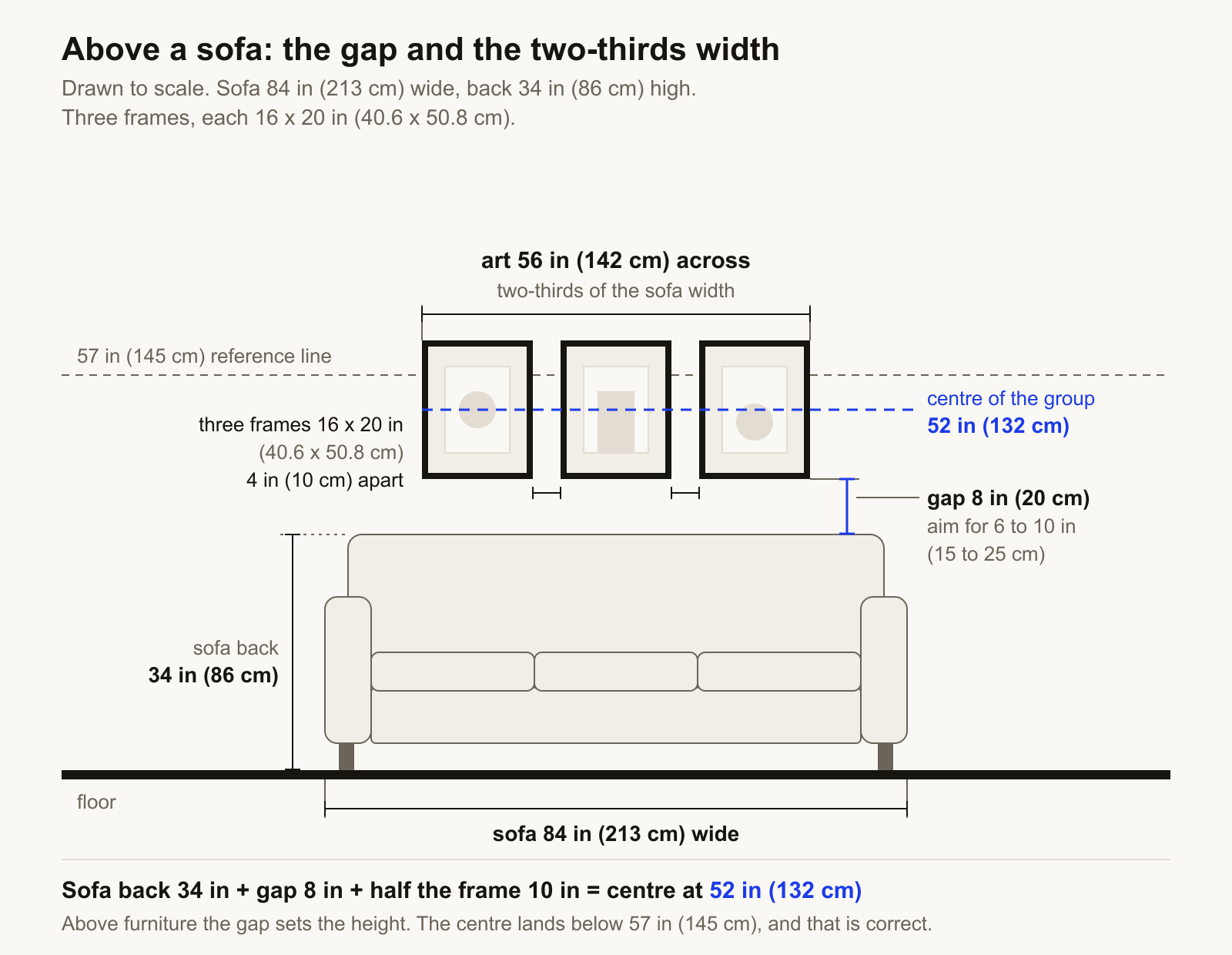
Furniture changes the rule. A picture above a sofa belongs to the sofa, so the gap between them matters more than the distance from the floor. Leave 6 to 10 in (15 to 25 cm) between the top of the furniture and the bottom of the frame. Less and heads touch the frame. Much more and the picture drifts away from the thing it belongs to.
For width, aim for art that spans about two-thirds of the furniture below it. Over a sofa 84 in (213 cm) wide, that is 56 in (142 cm): one large piece, or three frames 16 in (40.6 cm) wide with 4 in (10 cm) between them.
Now check the height. With a sofa back at 34 in (86 cm), a gap of 8 in (20 cm) and frames 20 in (50.8 cm) tall, the centre lands at 34 + 8 + 10 = 52 in (132 cm). That is below the usual line, and it is correct. Above furniture, the gap wins.
A console or a mantel works the same way. Over a mantel the lower end of the gap range usually looks better, because the shelf is already high on the wall.
Art above a bed
Art above a bed follows the sofa rule, with the headboard standing in for the sofa back. Leave 6 to 10 in (15 to 25 cm) above the headboard, and keep the arrangement to about two-thirds of the width of the bed: roughly 40 in (102 cm) of art over a bed 60 in (152 cm) wide.
With no headboard, measure the gap from the top of the pillows as they sit against the wall. Choose light frames here, fix each one at two points so it cannot swing, and consider acrylic glazing in place of glass. Whatever fixing you use, check the weight rating printed on its pack against the weight of the framed picture.
Stairs, low ceilings and rooms where people sit
Stairs
On a staircase the floor rises, so the line rises with it. Measure 57 in (145 cm) straight up from the front edge of the step directly below each picture. The centres then climb at the same angle as the stairs.
Low ceilings
Under a ceiling lower than 8 ft (244 cm), stay at the bottom of the range. If a tall frame still crowds the ceiling, choose a landscape format rather than hanging it lower.
Dining rooms, studies and other seated rooms
Where a picture is mostly seen from a chair, lower the centre slightly. Sit down and look before marking the wall.
Groups: treat the whole arrangement as one picture
A pair, a row or a grid is one shape. Find the outer rectangle of the whole arrangement and put its centre on the line, or set its bottom edge by the furniture gap. Keep the spacing between frames even: 2 to 4 in (5 to 10 cm), wider for larger frames.
A grid of nine shows the arithmetic. Frames 12 in (30.5 cm) wide and 15 in (38 cm) tall on the outside, set 2 in (5 cm) apart, make a block 40 in (102 cm) wide and 49 in (124 cm) tall. Centred on 57 in (145 cm), its top edge is at 81.5 in (207 cm) and its bottom edge at 32.5 in (83 cm). The three rows have their centres at 74, 57 and 40 in (188, 145 and 102 cm). Each frame then gets its own nail from the same sum, using the centre of its row.
A note on what wallnine sells: print files, not frames or hardware. The files are cut to the common frame ratios, so a print can go into a standard frame, and sets come as 3, 6 or 9 artworks, which a row or a grid suits. The files a print ships with are listed on its own page.
Questions people ask
How high to hang a picture on an empty wall?
Put the centre 57 in (145 cm) above the floor, or up to 60 in (152 cm) under high ceilings. The nail goes higher than that: add half the frame height and subtract the drop of the wire.
What height to hang pictures above a sofa?
Set the bottom of the frame 6 to 10 in (15 to 25 cm) above the sofa back and let the centre fall where it falls. It usually lands a little below the standard line, which is fine.
Is picture hanging height measured to the top, the nail or the centre?
The centre. The top edge and the nail both depend on the frame, so two frames with matching tops or matching nails will not line up. Matching centres will.
How high to hang art that is very large?
The same centre line works for most large pieces. If the frame is tall enough that its bottom edge drops close to the furniture or the floor, raise it until the space below looks deliberate, and accept a higher centre.