The 4:5 aspect ratio and the four other common print shapes
An aspect ratio is a frame's shape, not its size. Here are the five common shapes a framed print falls into, the standard sizes in each, and how to check a frame or a file before printing.
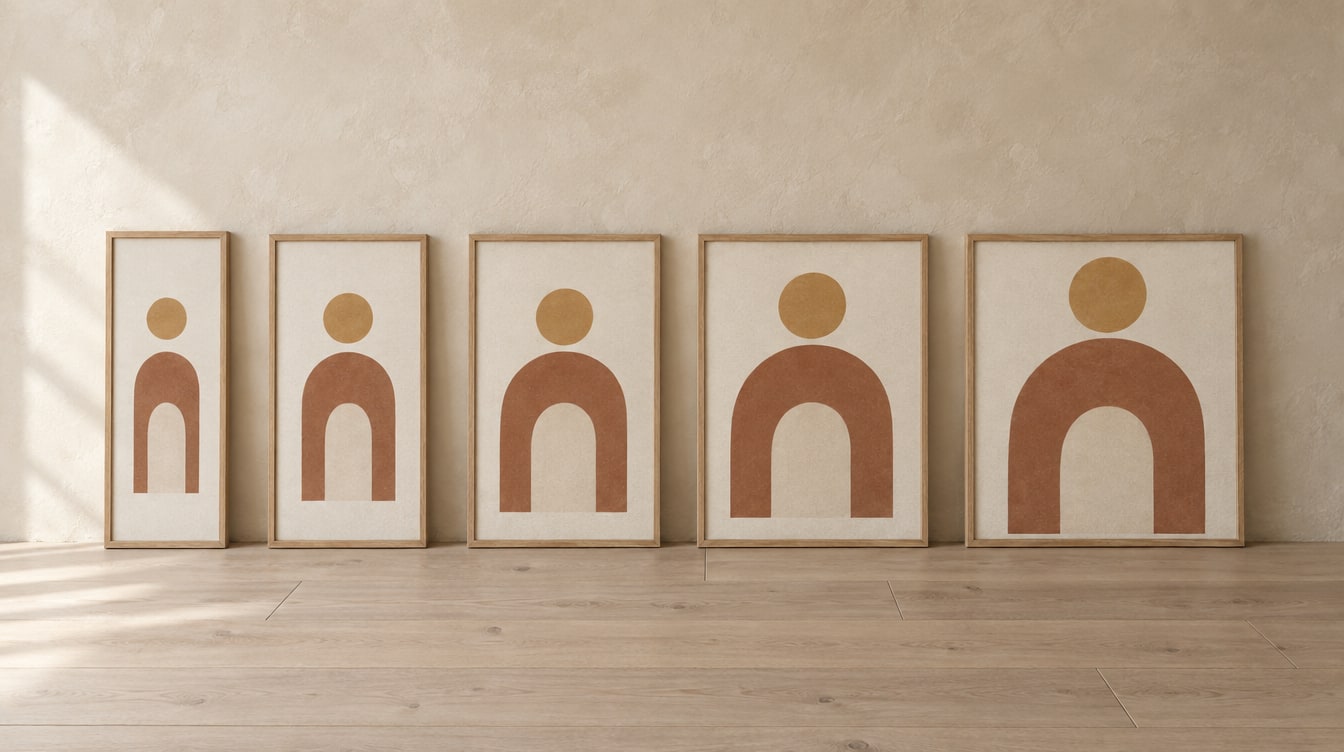
A frame has a shape before it has a size. The 4:5 aspect ratio is the shape of an 8 x 10 in (20.3 x 25.4 cm) frame and of a 16 x 20 in (40.6 x 50.8 cm) one: different sizes, identical proportions. Print a file of another shape into either and something has to give.
What follows is an aspect ratio cheat sheet for print: five common shapes, the standard sizes in each, and a quick check for a frame and a file.
What an aspect ratio is
An aspect ratio compares a rectangle's width with its height. It describes shape, not size. A 2:3 print is two units wide for every three tall, whether the unit is an inch, a centimetre or a pixel, so a 4 x 6 in (10.2 x 15.2 cm) photo and a 24 x 36 in (61.0 x 91.4 cm) poster are the same shape.
The order of the numbers only says which way up it is. A 3:2 aspect ratio is a landscape; a 2:3 aspect ratio is the same shape turned upright. Ratios here are written portrait, short side first. Each also has a decimal, the short side divided by the long side: 0.667 for 2:3, 0.8 for 4:5.
The five common print shapes
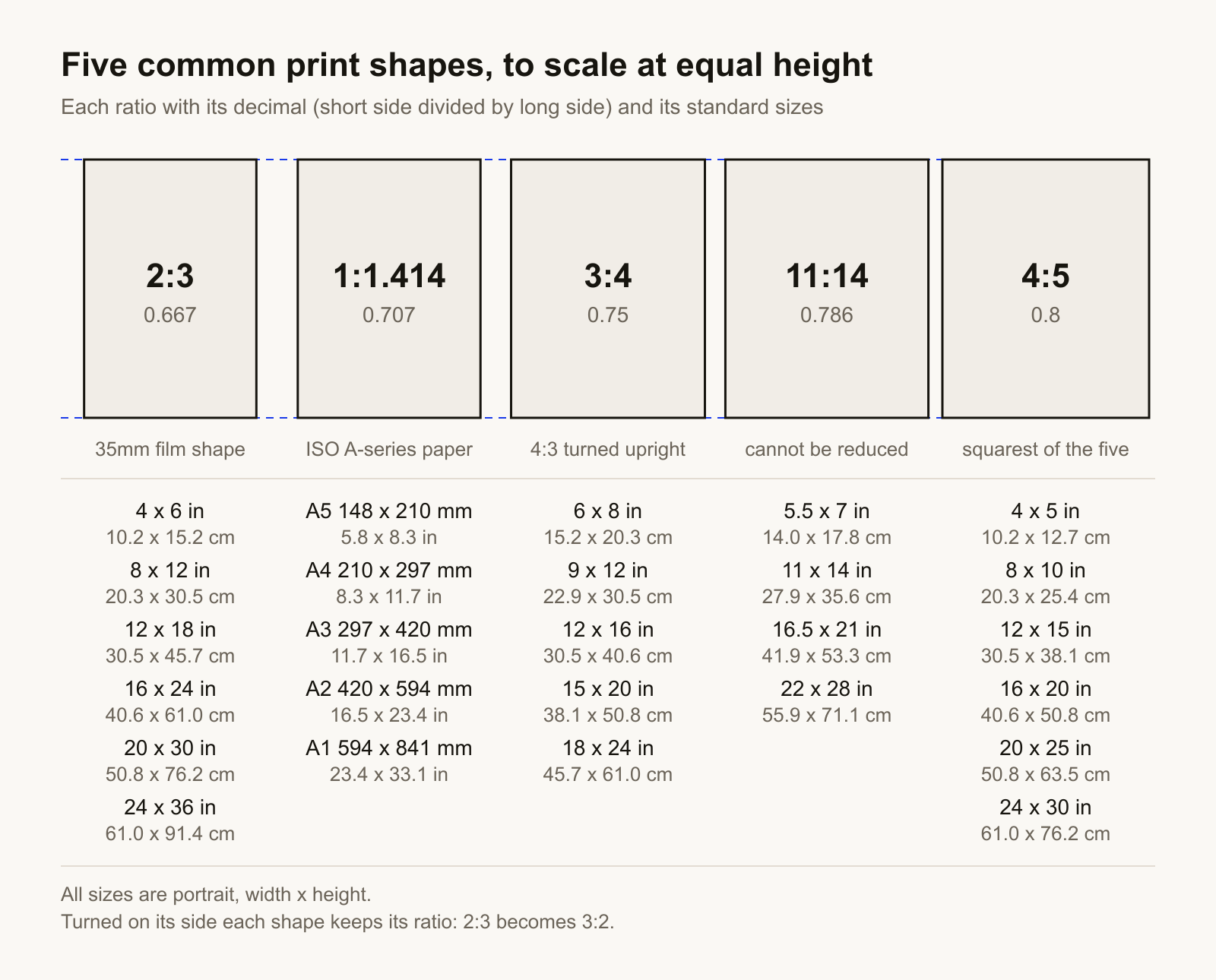
2:3 (0.667)
The shape of a 35mm film frame, and the tallest and narrowest of the five. Photo prints and large posters sit here.
- 4 x 6 in (10.2 x 15.2 cm)
- 8 x 12 in (20.3 x 30.5 cm)
- 12 x 18 in (30.5 x 45.7 cm)
- 16 x 24 in (40.6 x 61.0 cm)
- 20 x 30 in (50.8 x 76.2 cm)
- 24 x 36 in (61.0 x 91.4 cm)
ISO A-series, 1:1.414 (0.707)
The international paper standard, ISO 216. The long side is the short side multiplied by the square root of two, so a sheet cut in half gives the next size down in the same shape.
- A5 — 148 x 210 mm (5.8 x 8.3 in)
- A4 — 210 x 297 mm (8.3 x 11.7 in)
- A3 — 297 x 420 mm (11.7 x 16.5 in)
- A2 — 420 x 594 mm (16.5 x 23.4 in)
- A1 — 594 x 841 mm (23.4 x 33.1 in)
3:4 (0.75)
Most phone cameras shoot 4:3 by default, which is this shape on its side.
- 6 x 8 in (15.2 x 20.3 cm)
- 9 x 12 in (22.9 x 30.5 cm)
- 12 x 16 in (30.5 x 40.6 cm)
- 15 x 20 in (38.1 x 50.8 cm)
- 18 x 24 in (45.7 x 61.0 cm)
11:14 (0.786)
Eleven and fourteen share no common factor, so this ratio cannot be reduced.
- 5.5 x 7 in (14.0 x 17.8 cm)
- 11 x 14 in (27.9 x 35.6 cm)
- 16.5 x 21 in (41.9 x 53.3 cm)
- 22 x 28 in (55.9 x 71.1 cm)
4:5 (0.8)
The shape of 4 x 5 in (10.2 x 12.7 cm) sheet film, and the squarest of the five.
- 4 x 5 in (10.2 x 12.7 cm)
- 8 x 10 in (20.3 x 25.4 cm)
- 12 x 15 in (30.5 x 38.1 cm)
- 16 x 20 in (40.6 x 50.8 cm)
- 20 x 25 in (50.8 x 63.5 cm)
- 24 x 30 in (61.0 x 76.2 cm)
Near misses: the 4:5 aspect ratio, 11:14 and 5:7
4:5 is 0.8 and 11:14 is 0.786: close, not equal. A 4:5 image scaled to fill an 11 x 14 in (27.9 x 35.6 cm) frame comes out 11.2 in (28.4 cm) wide, so 0.2 in (0.5 cm) is trimmed across the width, a sliver from each side. On most artwork that goes unnoticed; a border drawn close to the edge can show it.
5 x 7 in (12.7 x 17.8 cm) is its own ratio, 5:7 or 0.714, beside 0.707 for an A-size. An A-ratio file fills it with under a tenth of an inch (about 2 mm) trimmed from the height.
How to work out the ratio of any frame
- Find the print size the frame holds, on its label or backing board. If it has a mat, use the size the mat is cut for, not the outer frame size.
- Find the largest whole number that divides both sides, the greatest common divisor. For a 16 x 20 in (40.6 x 50.8 cm) frame it is 4; for 24 x 36 in (61.0 x 91.4 cm) it is 12.
- Divide both sides by it: 16 and 20 become 4:5, 24 and 36 become 2:3.
- If nothing divides both, the size is its own ratio: 11 and 14 stay 11:14.
The shortcut works in any unit. Divide the short side by the long side and compare the result with the five decimals: 0.667, 0.707, 0.75, 0.786 and 0.8. Work to three decimal places. A measured frame lands a few thousandths either side of its ratio; 0.786 and 0.8 are different shapes. A 50 x 70 cm (19.7 x 27.6 in) frame gives 0.714, none of the five: it is 5:7, the shape of a 5 x 7 in (12.7 x 17.8 cm) frame.
How to check a file's ratio from its pixels
A file has no inches until it is printed, only pixels, and the same division works. Read the pixel dimensions from the file's properties or details. 4000 x 5000 pixels is 0.8, so the file is 4:5; 3600 x 5400 is 0.667, so it is 2:3. A result that does not match the frame's decimal means the file needs cropping for that frame.
The ratio says which frames a file fits; the pixel count says how large it can go. Labs usually ask for 300 pixels per inch at the print size, which for 16 x 20 in (40.6 x 50.8 cm) is 4800 x 6000 pixels. Large prints viewed from across a room look sharp at less.
What happens when the ratio is wrong
A printer can do two honest things with a file of the wrong shape: fill the paper and crop what overhangs, or fit the whole image and leave blank bars. Lab order pages usually offer both, often labelled fill and fit. Stretching distorts everything and is never right.
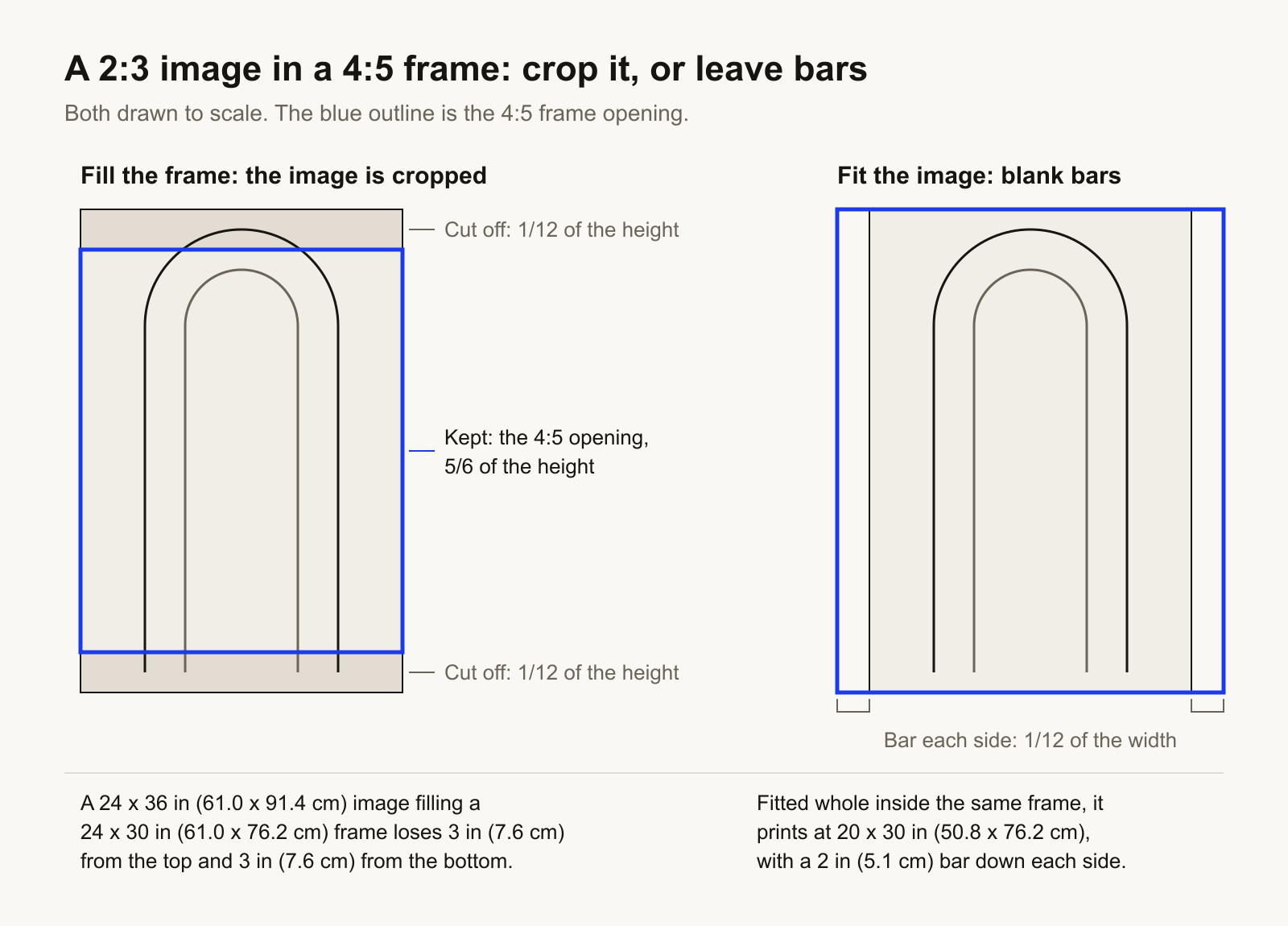
Take a 2:3 poster file, 24 x 36 in (61.0 x 91.4 cm), and a 4:5 frame, 24 x 30 in (61.0 x 76.2 cm). Filling the frame cuts away one sixth of the height: 3 in (7.6 cm) from the top and the same from the bottom if the crop is centred. Fitting instead prints the image at 20 x 30 in (50.8 x 76.2 cm) with a blank bar of 2 in (5.1 cm) down each side.
Automatic cropping is centred and blind. It does not know that the top of the picture held the horizon, or the last line of a quote.
Why printable art comes as a file per ratio
This is why a shop selling printable art supplies a file for each ratio: the crop is settled once, in advance, instead of by a kiosk's fill button. wallnine prints are cut to the common frame ratios, and the files a print ships with are listed on its own page.
For a set, settle the ratio first. A wallnine set is 3, 6 or 9 artworks, and the wall reads as one piece when every frame is the same shape.
Questions people ask
Is a 3:2 aspect ratio the same as 2:3?
Yes. It is one shape: 3:2 is landscape, 2:3 is portrait. A 2:3 file turned on its side fills a 3:2 frame exactly.
What ratio is a 16x20 frame?
4:5, the same as 8 x 10 in (20.3 x 25.4 cm). If it is matted for an 11 x 14 in (27.9 x 35.6 cm) print, it needs an 11:14 file.
What ratio is an 11x14 frame?
11:14, or 0.786. Close to 4:5 but not the same: a 4:5 file loses 0.2 in (0.5 cm) of its width in one.
What ratio is a 24x36 poster?
2:3, the same as a 4 x 6 in (10.2 x 15.2 cm) photo. In metric, 61.0 x 91.4 cm.
What is A2 size in inches?
A2 is 420 x 594 mm, or 16.5 x 23.4 in. That is the A2 frame size to look for. It is not interchangeable with 16 x 24 in (40.6 x 61.0 cm), which is 2:3.