How to hang pictures without nails, by frame weight and wall
Six ways to get prints on the wall without a hammer, the frame weights and wall surfaces each one suits, and how to take them down without lifting the paint.
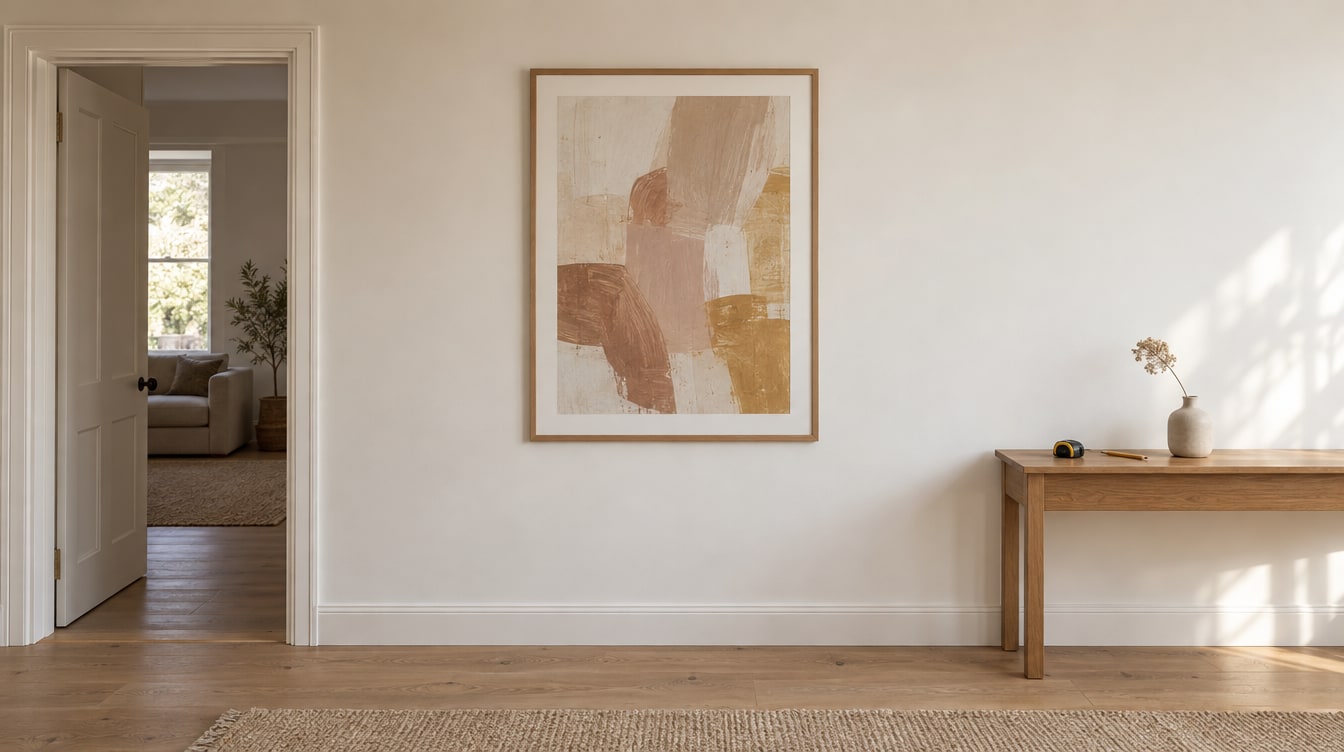
A nail is the usual way to hang a frame, and it is not always allowed or wise. A lease may forbid holes, old plaster can crumble, and tile will not take a nail at all. This guide covers how to hang pictures without nails: six methods, what each suits, and where each fails.
Start with the frame's weight and the wall's surface
Weigh the frame as it will hang, with glazing, mat and backing in place. A kitchen scale handles a small frame. For a larger one, stand on a bathroom scale with and without the frame and subtract.
Glazing is often the heaviest part. Picture glass about 5/64 in (2 mm) thick weighs close to 1 lb per square foot (about 5 kg per square metre), so the glass alone in a 24 x 36 in (61 x 91.4 cm) frame is about 6 lb (2.8 kg). Acrylic of the same thickness weighs roughly half as much.
Then the wall. Adhesive bonds to paint, not to the wall behind it.
- Smooth painted drywall (plasterboard) — what adhesive products are designed around, once the paint has cured.
- Plaster — often old and many paint layers deep. Adhesive is only as strong as the weakest layer.
- Glazed tile — smooth and non-porous, so adhesive grips well. Keep off the grout.
- Textured walls — orange peel or woodchip touches a strip only at the high points, so adhesive is unreliable.
- Fresh paint — dry in hours, cured much later. Some packs ask for at least seven days after painting; check the pack and the tin.
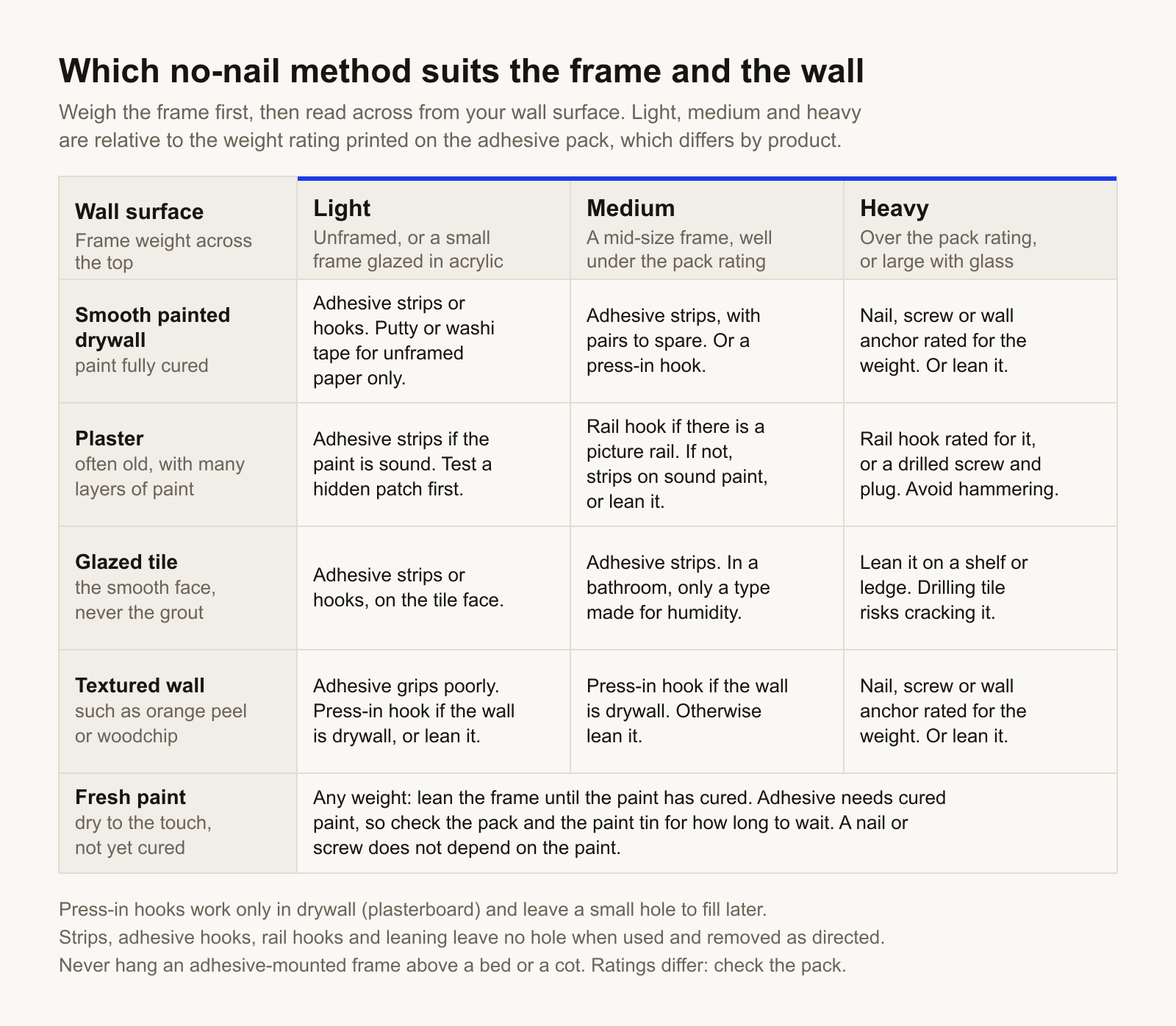
How to hang pictures without nails, method by method
Adhesive picture-hanging strips
Two interlocking strips, one on the frame and one on the wall, that click together. They hold the frame flat and leave no hole. They need a flat frame back: take off any sawtooth hanger or wire that holds the frame off the wall, and on a recessed back fix the strips to the rim. The pack states the weight a given number of pairs will carry. Use more pairs than the minimum and stay well under the rating.
Adhesive hooks
A hook on the same stretch-release adhesive. The frame hangs from its wire or sawtooth hanger and lifts off easily, but the whole load rests on one small pad. Keep these for light frames.
Picture rails and rail hooks
A picture rail is a moulding fixed along the wall near the ceiling, common in older houses with plaster walls. A metal rail hook sits over it and the frame hangs below on cord, wire or chain. Nothing touches the wall, and frames slide sideways. Modern track systems work the same way but are screwed up first, so in a rental, ask the landlord.
Leaning on a shelf, ledge or mantel
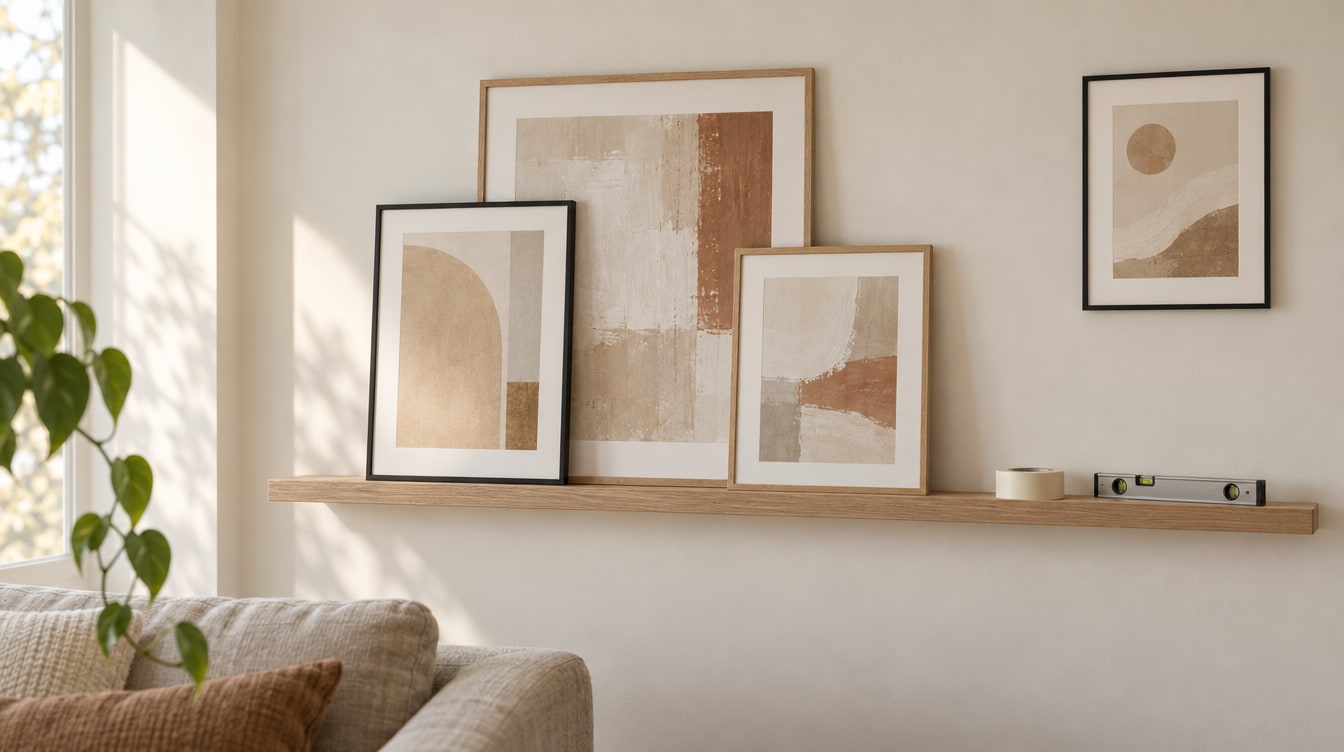
A leaning frame needs no fixing. A mantel, a sideboard, a deep shelf or the floor will do. A picture ledge, a narrow shelf with a lip, needs screws unless one is already there. Put the largest frame at the back and a pea of removable putty under each bottom edge. It is also the easy way to hang pictures you swap often: nothing to level, nothing to patch.
Press-in hooks for drywall
A curved steel wire hook pushed through drywall by hand that braces against the back of the board. The board takes the load, not the paint. It leaves a small hole to fill when you move out, and it works only in drywall, not in plaster, brick or tile. Keep clear of the wall directly above, below and beside switches and sockets, where cables often run.
Washi tape and poster putty
For unframed paper only. Washi, a low-tack paper tape, goes across the corners of a print as part of the display. Poster putty goes behind them. Putty can leave a faint oily mark on matt paint, and on the print, over time, and both can let go in a humid room. Keep them for a print you can run off again, which a downloaded file always is.
Surface prep that decides whether adhesive holds
Most adhesive failures are prep failures. Where the pack says otherwise, follow the pack.
- Mark the position. The gallery convention puts the centre of a picture about 57 in (145 cm) from the floor.
- Wipe the wall with isopropyl rubbing alcohol and let it dry. Household cleaners leave a film, and the adhesive sticks to that instead.
- Click the strips together in pairs, stick each pair to the frame back and press firmly for the time the pack gives, commonly around 30 seconds. Then peel the wall-side liners.
- Rest a spirit level on the frame, press it to the wall and hold for the same time. Strips allow very little adjustment afterwards.
- Some packs then ask you to lift the frame off, press the wall-side strips again and wait, often about an hour, before rehanging.
Keep adhesive away from heat and damp: not above a radiator, not in a steamy bathroom unless the product is made for one. Do not hang an adhesive-mounted frame above a bed or a cot.
Taking it down without taking the paint
Stretch-release adhesive comes away cleanly only when it is stretched, not peeled. Unclip the frame by lifting its bottom edge up and away. Then pull the tab on the wall strip slowly straight down, parallel to the wall. The tab stretches a long way before it lets go. Pulling it out towards you is what tears paint.
If a tab snaps, warm the strip with a hairdryer for twenty to thirty seconds and saw behind it with dental floss. A press-in hook pulls straight out, and filler closes the hole.
When a nail is the right answer
Adhesive tends to fail without warning, and a falling glazed frame is a hazard. If the frame weighs more than the pack allows, is large and glazed in glass, is a mirror, or will hang over a bed, a sofa or a doorway, use a mechanical fixing: a picture hook and nail, a screw into a stud, or a wall anchor rated for the load. On plaster, drill a pilot hole first, because hammering can crack or loosen old plaster. One small filled hole is a smaller repair than torn paint, and some leases allow a few. Ask first.
Lighter frames make every method easier
A print made from a downloaded file goes into whatever frame you choose, so choose a light one: a slim moulding, and acrylic instead of glass. wallnine files are cut to the common frame ratios, so a print can usually go into a ready-made frame of a matching ratio without custom framing. The files a print ships with are listed on its own page.
A set of 3, 6 or 9 means that many frames to keep in line, and a nail hole that is slightly out stays out. A rail hook slides into place, a misplaced strip costs a new strip, and a row on a ledge needs no measuring.
Questions people ask
What is the best way to hang pictures in a rental?
For light and mid-size frames on smooth, cured paint, adhesive strips used well inside the pack rating. For anything heavier, lean it or ask the landlord about a fixing. Hanging pictures without nails means matching the method to the load.
How do you hang pictures on plaster walls?
Use the picture rail if there is one. Without one, adhesive strips work only where the paint is sound: press one on a hidden patch, leave it a day, remove it properly and see what comes away. For a heavy frame, drill for a screw and wall plug.
How do you hang a heavy picture?
With a mechanical fixing, not adhesive. Weigh it, then use a hook, screw or anchor rated above that weight, into a stud or solid masonry where you can. If no hole is allowed, lean it.
How do you hang pictures on a wall without nails or any holes?
For a framed picture, four methods leave no hole when used as directed: adhesive strips and adhesive hooks removed by stretching the tab, a rail hook on an existing picture rail, and leaning. Tape and putty leave none either, but suit unframed paper only. Press-in hooks avoid the hammer but leave a small hole.