Standard picture frame sizes, and the print ratio each one takes
A reference to the standard ready-made frame sizes in inches and centimetres, grouped by aspect ratio, with how to measure a frame and what a mat does to the print you need.
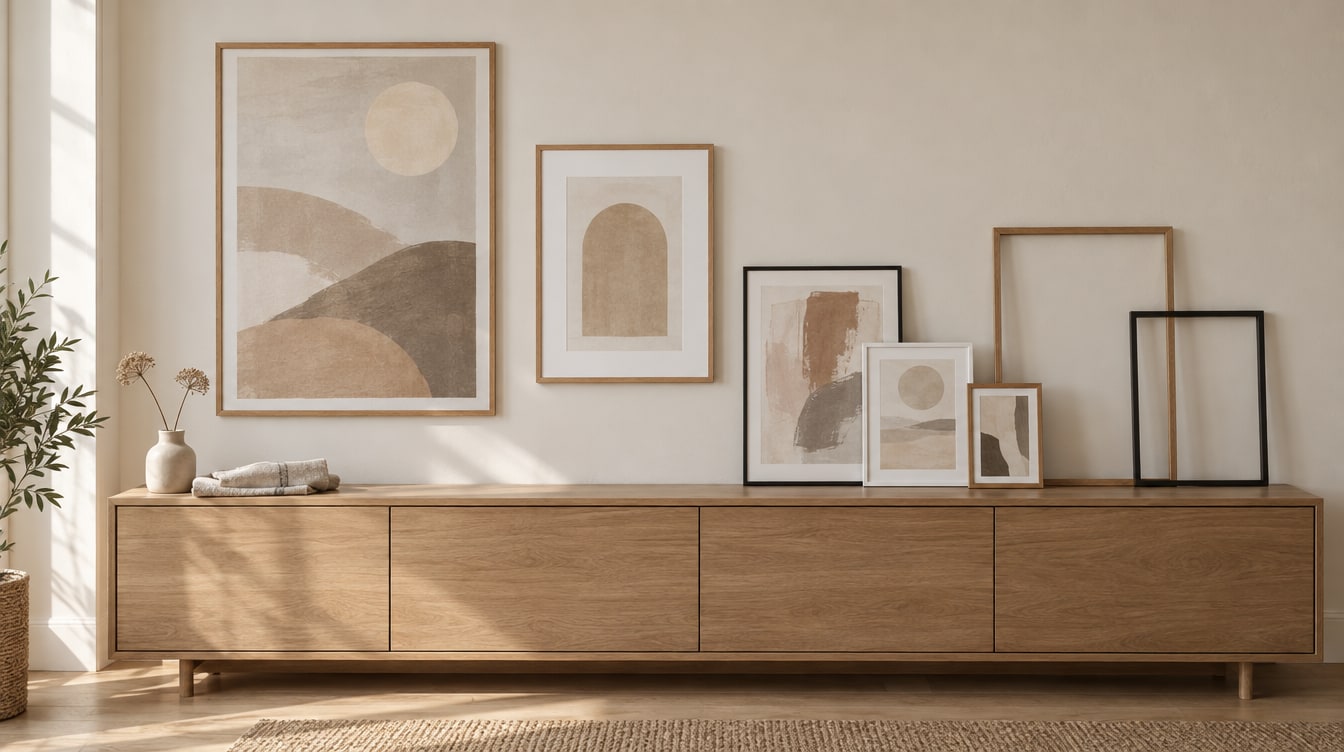
Most ready-made picture frame sizes fall into a handful of aspect ratios. Know the ratio and the rest follows: which print fills the frame without cropping, which sizes scale into each other, and which only work with a mat.
Each size below is the one printed on the frame's label, grouped by ratio. Buy the frame first, then print the ratio that fits it.
Why the ratio matters more than the size
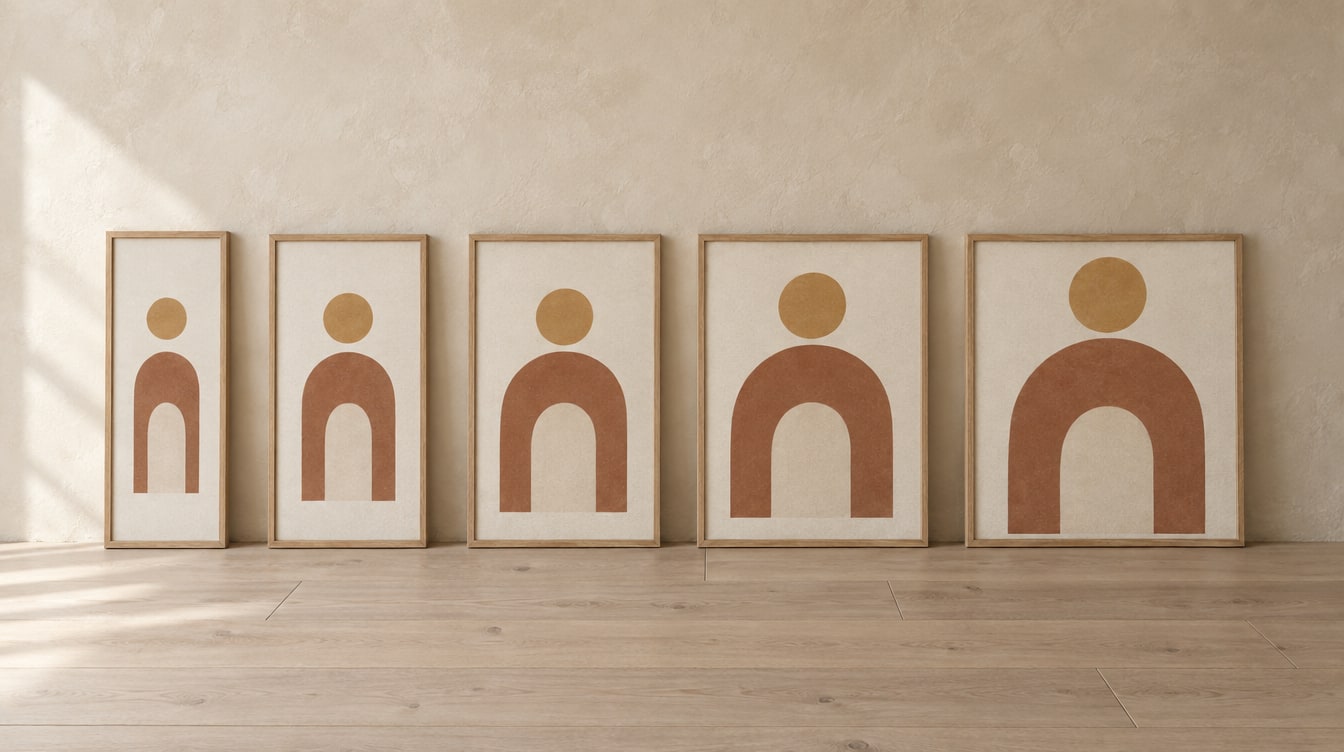
An aspect ratio is the width set against the height, reduced to small numbers. An 8 x 10 in (20.3 x 25.4 cm) frame and a 16 x 20 in (40.6 x 50.8 cm) frame are both 4:5, so one image fills either with nothing lost. Put that image in a 2:3 frame and either a strip is cropped off or a border is left showing.
An 11 x 14 in frame looks like 4:5 and is not: a 4:5 print scaled to 11 in (27.9 cm) wide is 13.75 in (34.9 cm) tall, 1/4 in (6 mm) short of the 14 in (35.6 cm) the frame takes, so it can slide and show a gap.
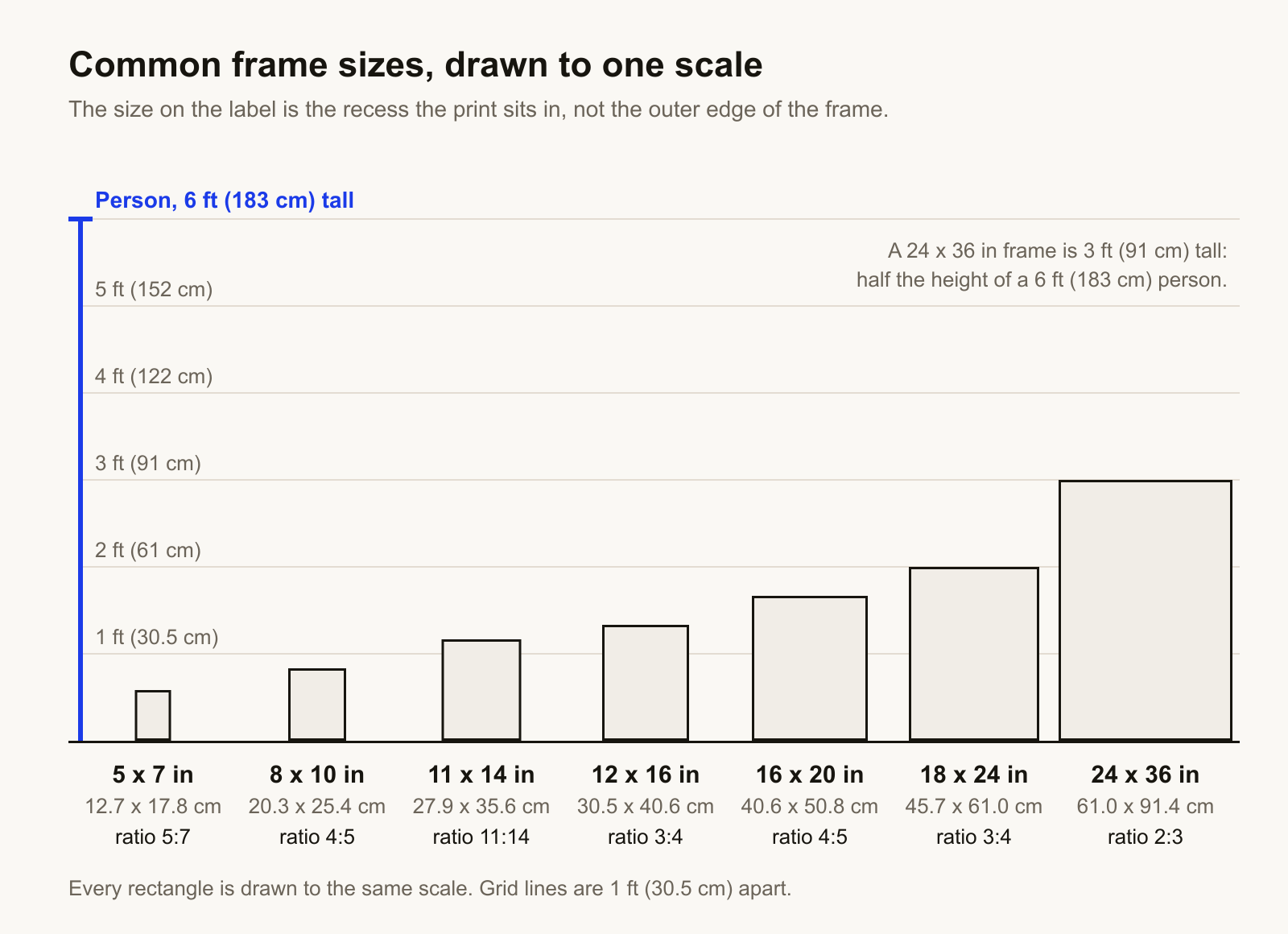
Standard picture frame sizes by aspect ratio
These are the common frame sizes sold ready-made in inch-based markets, with what each suits.
2:3, the photo ratio
2:3 is the shape of a 35mm film frame, and many digital cameras kept it, which is why photo frame sizes start here.
- 4 x 6 in (10.2 x 15.2 cm) — the standard photo print; shelves and desks
- 8 x 12 in (20.3 x 30.5 cm) — a small gallery-wall piece
- 12 x 18 in (30.5 x 45.7 cm) — medium; a narrow wall
- 16 x 24 in (40.6 x 61.0 cm) — a large single piece
- 20 x 30 in (50.8 x 76.2 cm) — above a desk or console
- 24 x 36 in (61.0 x 91.4 cm) — largest common size; above a sofa or bed
3:4
- 6 x 8 in (15.2 x 20.3 cm) — small; shelves and tight grids
- 9 x 12 in (22.9 x 30.5 cm) — gallery walls
- 12 x 16 in (30.5 x 40.6 cm) — medium; pairs and rows of three
- 18 x 24 in (45.7 x 61.0 cm) — large; also a poster size
4:5
- 8 x 10 in (20.3 x 25.4 cm) — small; desks, shelves and gallery walls
- 16 x 20 in (40.6 x 50.8 cm) — medium to large; enough on its own above a desk
- 24 x 30 in (61.0 x 76.2 cm) — large; above furniture
11:14, 5:7 and 5:6
- 5 x 7 in (12.7 x 17.8 cm) — 5:7; the usual print in a matted 8 x 10 frame
- 11 x 14 in (27.9 x 35.6 cm) — 11:14; the usual print in a matted 16 x 20 frame
- 22 x 28 in (55.9 x 71.1 cm) — 11:14; a large poster-style frame
- 20 x 24 in (50.8 x 61.0 cm) — 5:6; usually matted around a 16 x 20 print
Square
Square frames are 1:1 at every size: commonly 8 x 8 in (20.3 cm), 10 x 10 in (25.4 cm), 12 x 12 in (30.5 cm), 16 x 16 in (40.6 cm) and 20 x 20 in (50.8 cm). A rectangular print fits one only with a mat or a crop.
A sizes and metric frames
Outside North America, many frames follow ISO 216 paper sizes or round metric ones. Every A size has the same ratio, 1:1.414, and each is half the sheet above it.
- A5 — 148 x 210 mm (5.8 x 8.3 in)
- A4 — 210 x 297 mm (8.3 x 11.7 in)
- A3 — 297 x 420 mm (11.7 x 16.5 in)
- A2 — 420 x 594 mm (16.5 x 23.4 in)
- A1 — 594 x 841 mm (23.4 x 33.1 in)
The round metric sizes borrow the inch ratios: 30 x 40 cm (11.8 x 15.7 in) is 3:4, 40 x 50 cm (15.7 x 19.7 in) is 4:5 and 50 x 70 cm (19.7 x 27.6 in) is 5:7. Each sits close to an inch size without matching it, so print to the frame you own.
Poster frame sizes
The standard poster sizes are 11 x 17 in (27.9 x 43.2 cm), 18 x 24 in (45.7 x 61.0 cm), 24 x 36 in (61.0 x 91.4 cm) and the 27 x 40 in (68.6 x 101.6 cm) cinema one-sheet. Only 18 x 24 and 24 x 36 share a ratio with ordinary art prints.
Frame sizes on a wall: what each one suits
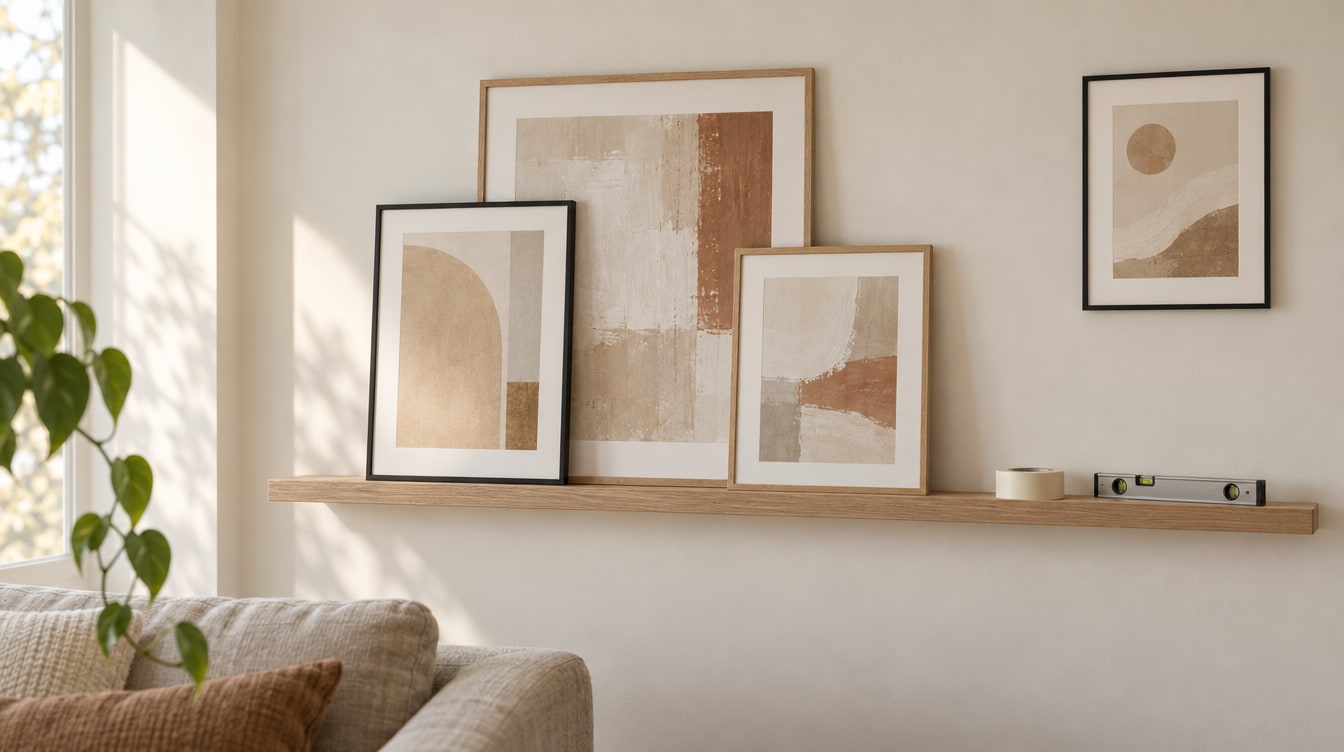
Hang art so its centre sits about 57 in (145 cm) from the floor, the eye-level line galleries use. Above a sofa or bed, let the art or group of frames span roughly two-thirds to three-quarters of the furniture's width.
Over a three-seat sofa of about 84 in (213 cm), that is 56 to 63 in (142 to 160 cm). One 24 x 36 in frame hung landscape covers only 36 in (91 cm). Three 16 x 20 in frames hung portrait with 3 in (7.6 cm) gaps cover 54 in (137 cm) before mouldings are counted. A three-by-three grid of 8 x 10 in frames with 2 in (5 cm) gaps covers 28 x 34 in (71 x 86 cm).
wallnine sells print files rather than paper, cut to the common frame ratios. The files a print ships with are listed on its own page, so check for your frame's ratio there. A set is 3, 6 or 9 artworks, which suits a row or grid of identical frames.
How to measure a frame
- Turn the frame over and remove the backing board.
- Measure the recess the glass sits in, width then height. That is the frame size: the number on the label, and the size of glass, mat or unmatted print it takes. Makers leave up to about 1/8 in (3 mm) of play, so round down to the nearest standard size.
- Measure the opening from the front. It is smaller, usually by about 1/4 in (6 mm) on each side, because the moulding's lip overlaps the glass. Keep anything that matters clear of that edge.
- Measure the outside of the moulding. Use it to plan spacing on the wall.
- If there is a mat, measure its window. That, not the frame, decides the print.
How a mat changes the print you need
A mat, called a mount in the UK, is a card border with a window cut in it. Its outside matches the frame size. Its window is cut slightly smaller than the print, so the print's edges tuck behind it.
Take a 16 x 20 in (40.6 x 50.8 cm) frame matted to 11 x 14 in (27.9 x 35.6 cm). The window is typically 10.5 x 13.5 in (26.7 x 34.3 cm), a 1/4 in (6 mm) overlap on every side. The mat border comes to 2.75 in (7.0 cm) at the sides and 3.25 in (8.3 cm) top and bottom. The frame's lip hides about 1/4 in (6 mm) of that, so the border you see is nearer 2.5 in (6.4 cm) and 3 in (7.6 cm). The frame is 4:5. The print it needs is 11:14.
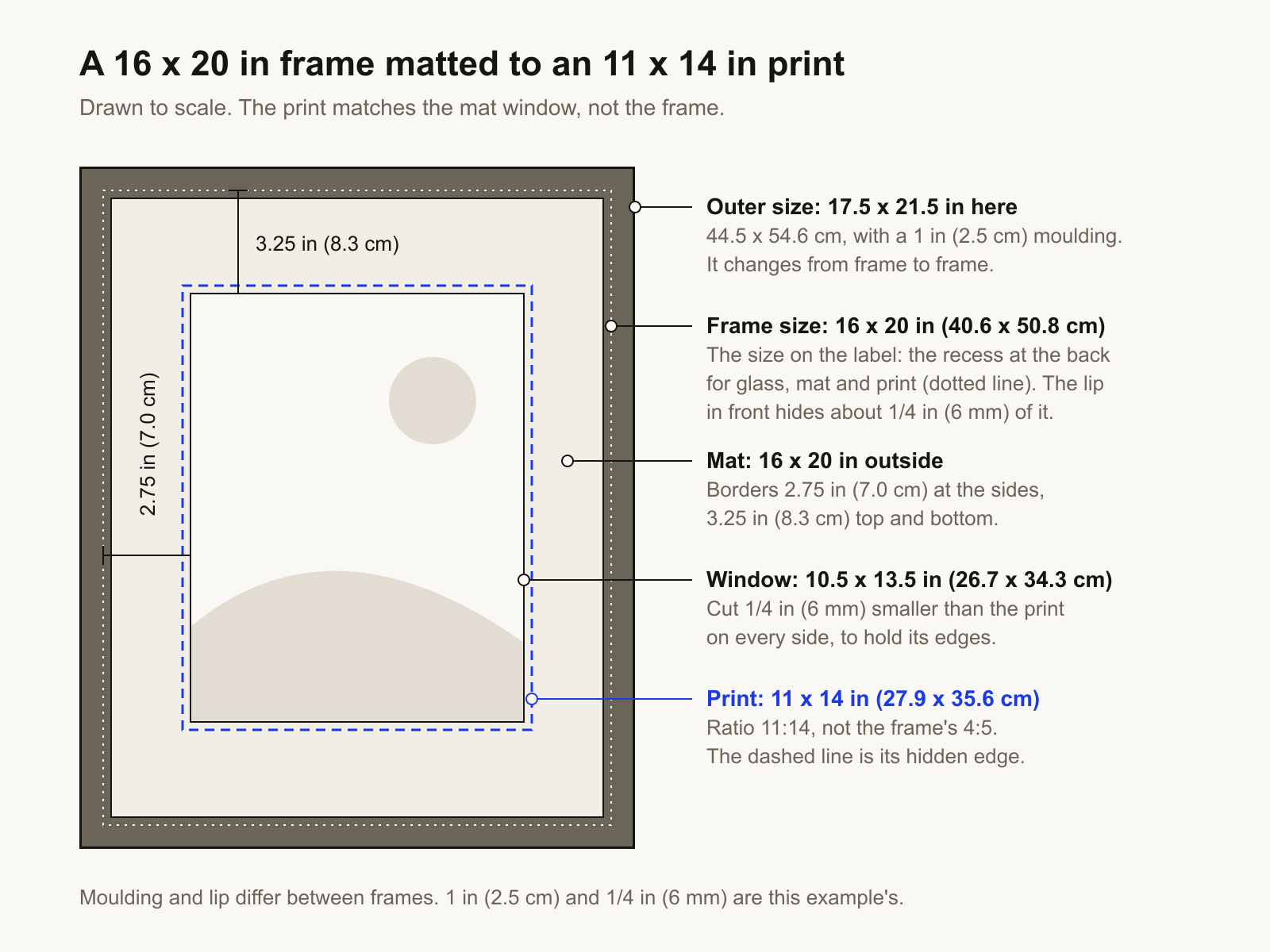
The usual pairings: an 8 x 10 in frame takes a 5 x 7 in print, an 11 x 14 takes an 8 x 10, and a 16 x 20 takes an 11 x 14. In metric, a 40 x 50 cm frame is commonly matted to 30 x 40 cm. Windows vary between makers, so measure before printing.
Questions people ask
What are the most common frame sizes?
In inches: 5 x 7, 8 x 10, 11 x 14, 16 x 20, 18 x 24 and 24 x 36. In metric markets: A4, A3, 30 x 40 cm, 40 x 50 cm and 50 x 70 cm.
What is A2 size in inches?
A2 is 420 x 594 mm, or 16.5 x 23.4 in. No common inch frame matches it. Use an A2 frame, or a larger frame with a mat cut to fit.
How do I measure a picture frame size?
Measure the recess at the back where the glass sits, width then height, and round down to the nearest standard size. The opening seen from the front is slightly smaller; the outer edge is larger by the moulding.